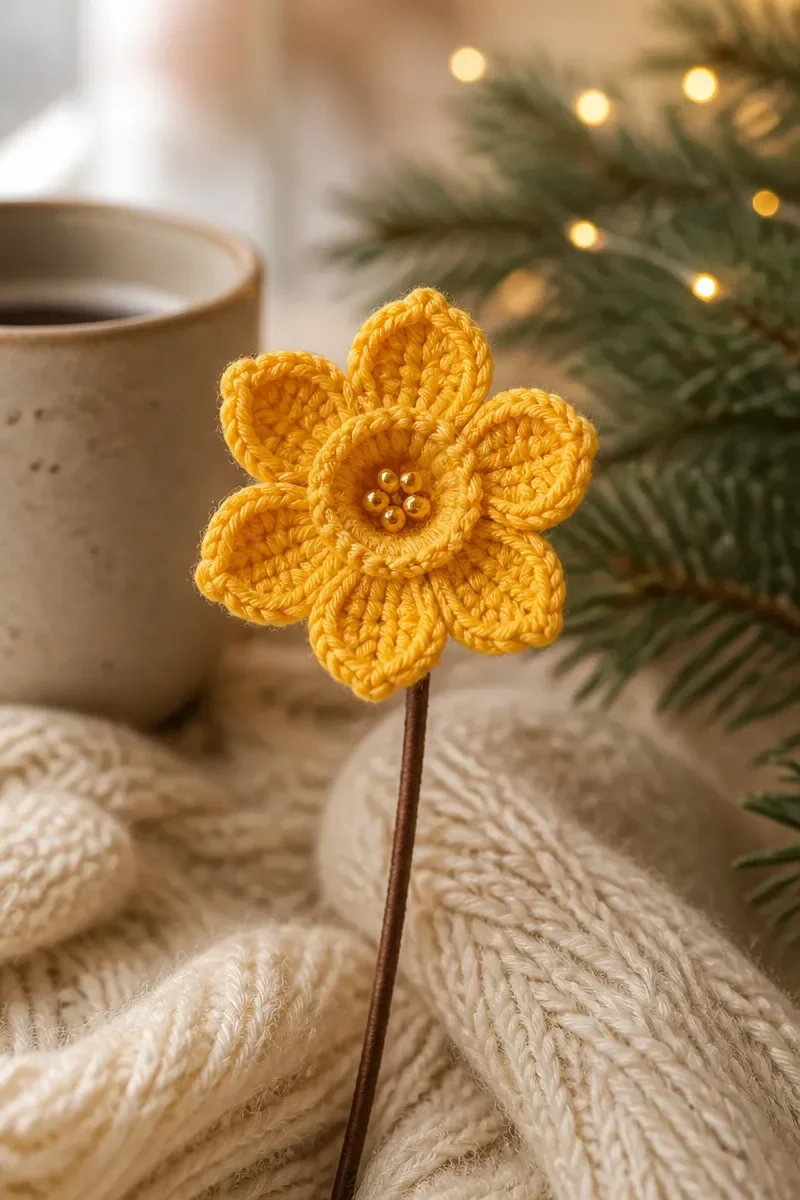
Golden Yellow Crochet Winter Jasmine Flower
Affiliate disclosure: This post may contain affiliate links. I may earn a small commission at no extra cost to you. See our Privacy Policy for details HERE.
- What Is a Crochet Flower?
- Why This Is a Great Choice for a Crochet Flower
- Before You Start
- Yarn and Hook Recommendations
- Materials
- Golden Yellow Crochet Winter Jasmine Flower Instructions
- Tips for Crochet Flower Success
- Common Mistakes to Avoid
- Ways to Make It Your Own
- Care and Washing Instructions
- Frequently Asked Questions
- More Ideas to Try
- Conclusion
The Golden Yellow Crochet Winter Jasmine Flower is a small crochet project for making a handmade floral keepsake. Its compact nature makes it a satisfying choice when you want to create something thoughtful with yarn and a few carefully chosen supplies.
This project can appeal to makers who enjoy detailed handwork and people looking for a personal present. A finished flower can be shared as a small gift or kept as a reminder of time spent making something by hand.
Working on a small project encourages patience and attention to detail. It can also build confidence with careful finishing and offer a pleasant way to practice making a handmade gift.
What Is a Crochet Flower?
A crochet flower is a small handmade motif that represents a familiar bloom through yarn. Its appearance can range from delicate and natural to playful and decorative, depending on the yarn and the maker’s choices. The finished motif is often appreciated for its compact form and handcrafted character.
Flowers made by crochet can be used as keepsakes, small gifts, or decorative accents. Their modest scale makes them suitable for arrangements and creative displays, while their handmade nature gives each one an individual quality. Some makers create one as a complete project; others enjoy making a collection.
Crocheters like floral motifs because they offer room for personal expression without requiring a large project. A flower can be adapted through yarn choice, presentation, and the way it is shared. The process also lets a maker enjoy focused handwork and create a personal item for someone else.
Why This Is a Great Choice for a Crochet Flower
- Small project: A compact motif offers a focused making session without requiring a large quantity of supplies. It can also be a pleasant way to use a quiet moment for creative work.
- Personal character: Handmade flowers carry the maker’s choices and attention in a form that feels individual. Each one can become a thoughtful token for someone who values crafted gifts.
- Flexible display: A floral motif can suit a range of decorative settings. Its small scale makes it straightforward to include in a display or offer as a standalone keepsake.
- Practice opportunity: A small project gives you room to build steady habits through close, attentive work. It can help you become more comfortable with careful handling and neat finishing.
- Gift potential: A handmade flower can be shared for a celebration, as a thank-you, or simply as a kind gesture. A personal note can make the gift feel even more meaningful.
Before You Start
- Make a gauge swatch when working with a new yarn and hook pairing. It helps you see how your fabric behaves before you commit to a larger project.
- Read through the complete project information before beginning. Knowing the sequence in advance can help you prepare supplies and avoid pausing to work out what comes next.
- Keep a notebook or tally sheet handy for recording progress and observations. A written record is useful when you set your work aside and return later.
- Arrange and wind your yarn before you begin. Keeping it orderly can help prevent tangles and let you focus on the work rather than managing loose strands.
Yarn and Hook Recommendations
- Choose a fiber that feels comfortable in your hands. Cotton has a crisp feel, while wool and acrylic can feel softer or more elastic during use.
- Match yarn weight to the kind of fabric you want. A lighter yarn generally creates a finer look, while heavier yarn produces a more substantial fabric.
- Try smooth yarn when you want individual loops to be easy to see. Textured or fuzzy yarn can make details harder to distinguish, especially in compact work.
- Consider how clearly your yarn shows the fabric. A solid, even surface can make the structure easier to read than a highly variegated or strongly textured strand.
- Select a hook that works comfortably with your chosen yarn. The yarn label can offer a starting point, while a swatch helps you judge the resulting fabric.
- Keep your yarn and hook pairing consistent throughout a project. Changing either midway can alter the fabric’s density and make separate sections look less uniform.
Materials
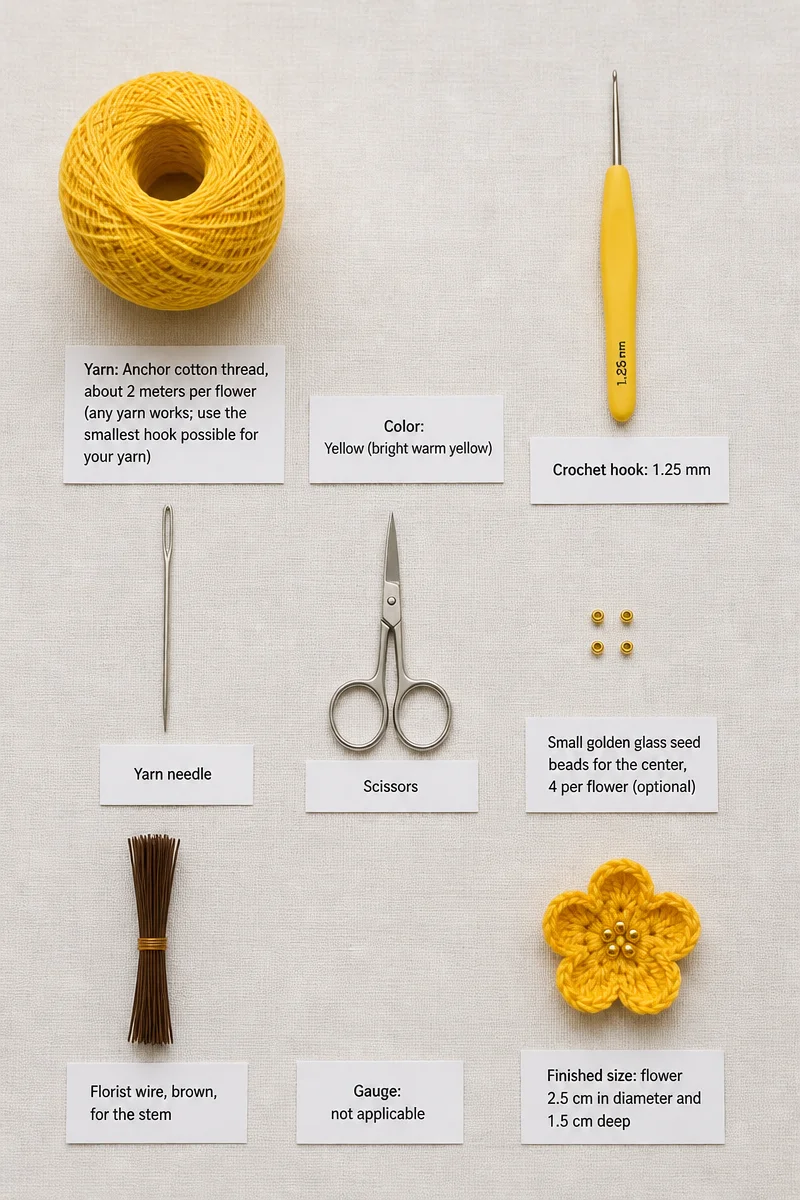
- Yarn: Anchor cotton thread, about 2 meters per flower (any yarn works; use the smallest hook possible for your yarn)
- Color: Yellow (bright warm yellow)
- Crochet hook: 1.25 mm
- Yarn needle
- Scissors
- Small golden glass seed beads for the center, 4 per flower (optional)
- Florist wire, brown, for the stem
- Gauge: not applicable
- Finished size: flower 2.5 cm in diameter and 1.5 cm deep
Golden Yellow Crochet Winter Jasmine Flower Instructions
Color key: Yellow = bright warm yellow.
Abbreviations: ch = chain; inc = increase (2 sc in the same st); sc = single crochet; sl st = slip stitch; st = stitch; tr = treble crochet.
Notes: The flower is worked in a spiral. Each flower is a single motif.
-
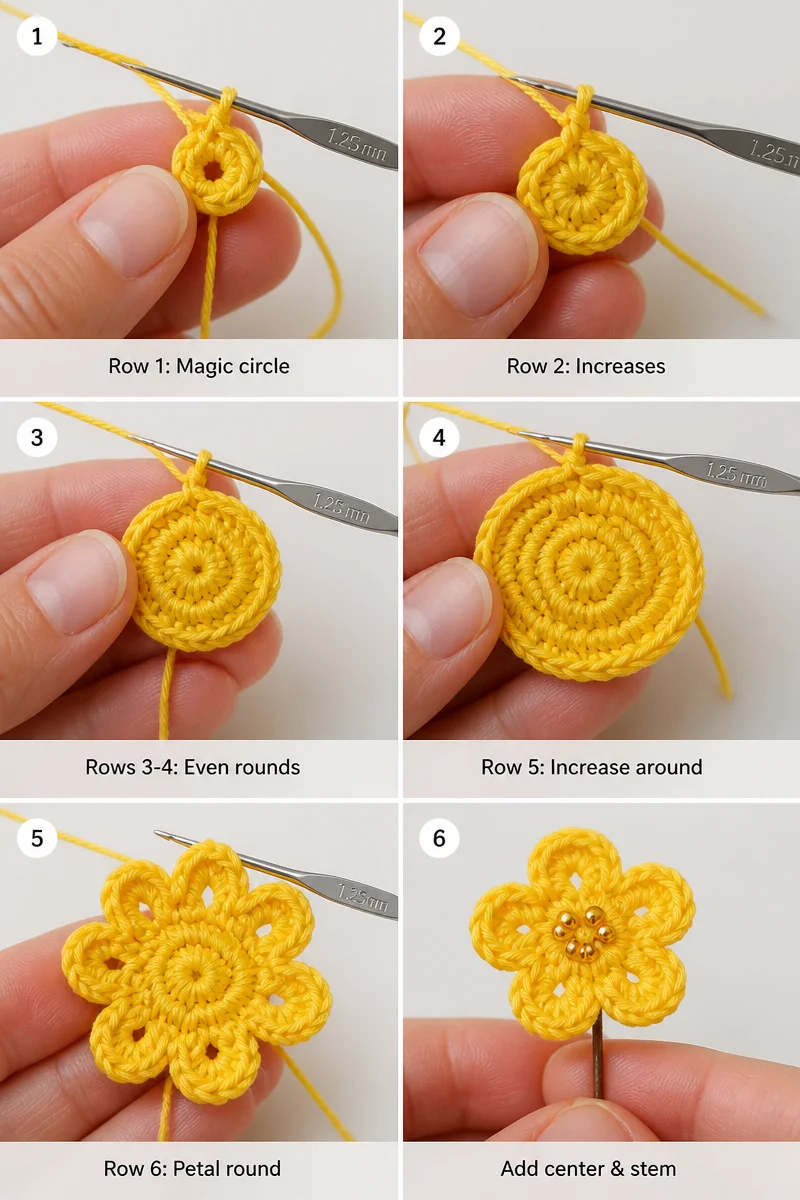
Row 1: Make a magic circle, ch 1, work 4 sc into the center of the magic circle. (4 sc)
-
Row 2: Sc inc, sc, sc inc, sc. (6 sc)
-
Rows 3-4: 6 sc in each row. (6 sc)
-
Row 5: Sc inc in each st around. (12 sc)
-
Row 6: *(Ch 2, 2 tr) in the same st, (tr, ch 2, sl st) in the same st, sl st. Repeat from * to * 5 more times. Fasten off, leaving a long tail.
Center
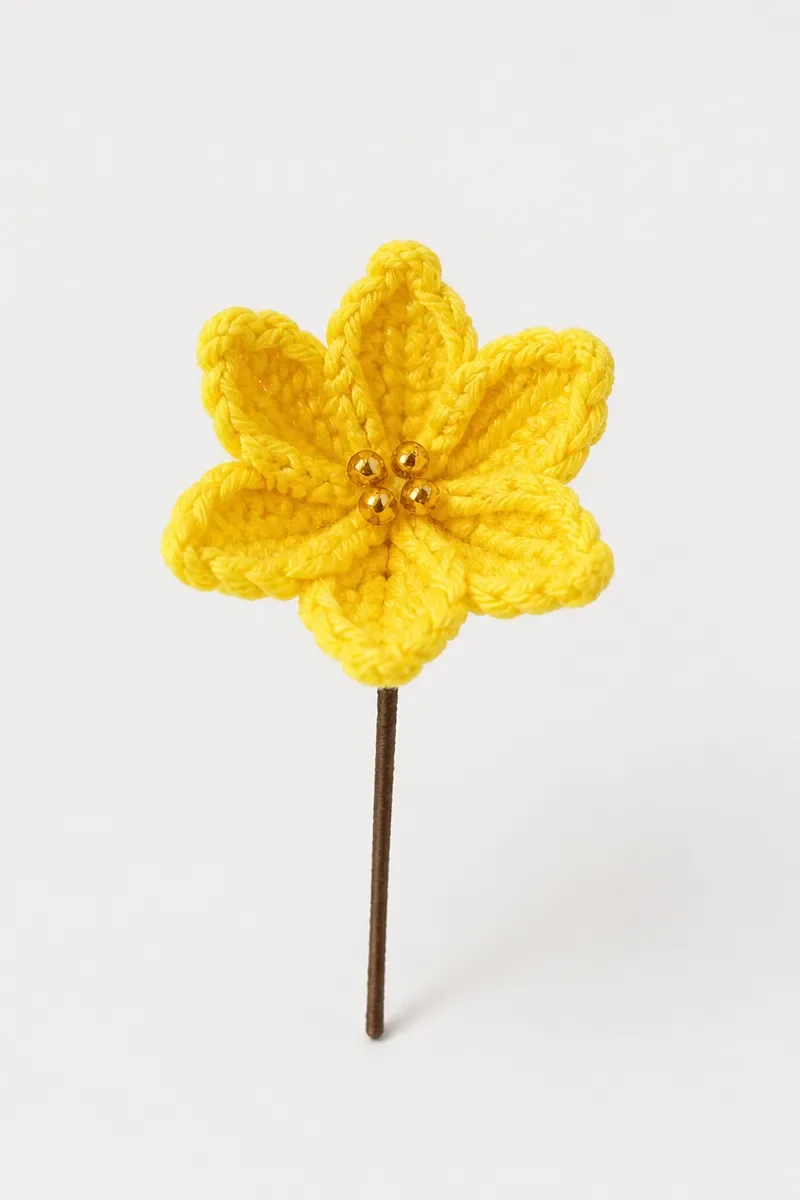
Using the long tail, sew 4 golden seed beads into the center of the flower as the stigma, in any way you choose. Fasten off and weave in the ends.
Stem
Open the magic circle to fit the flower onto a brown florist wire stem. Close the magic circle, fasten off in place and weave in the ends.
Tips for Crochet Flower Success
Comfortable posture
Sit in a position that lets your shoulders relax and your forearms rest comfortably. A supported posture can reduce unnecessary strain and make close handwork feel more manageable.
Even tension
Let the yarn travel smoothly through your fingers rather than pulling it tightly after every movement. A relaxed, consistent grip helps the fabric stay regular and keeps your hands from tiring as quickly.
If the yarn catches or feels difficult to move, pause and adjust how it passes through your hand. Comfort matters more than gripping firmly.
Track your place
Keep your attention on the section you are currently working and mark your progress on a tally sheet when useful. A written record can make it easier to resume after a break without relying on memory.
Check as you go
Pause occasionally to look over the fabric for consistency. Notice whether the surface feels even and whether the overall work is developing as expected, so you can address a concern while it is still easy to locate.
Common Mistakes to Avoid
Skipping a swatch
It is tempting to begin right away, especially when a project appears small. Yet a new yarn and hook combination can behave differently from familiar materials, affecting the density and feel of the fabric.
A small swatch offers a chance to assess that pairing before you continue. If the fabric seems too stiff or loose, adjust your approach before investing more effort.
Pulling too tightly
Tight tension can happen when a maker is concentrating or holding the yarn with too much force. The work may become difficult to handle, and inserting the hook through the fabric can take extra effort.
Keep your grip relaxed and let the strand move freely. If the fabric feels unusually firm, pause and loosen your hold rather than forcing the hook through.
Miscounting progress
It is easy to lose track when you are interrupted or when you set the work down. A count that drifts can affect the consistency of the fabric and make it harder to understand where you are.
Use a tally sheet to record progress as you go, and check your count at natural pauses. If something seems off, revisit the most recent section you can verify rather than guessing.
Leaving short tails
Short yarn tails can be difficult to secure neatly during finishing. They may also make it harder to weave the yarn through the fabric without pulling the work out of shape.
Leave enough yarn for a comfortable finish whenever a tail is needed. Keeping tails accessible until you are ready to secure them can also reduce the chance of accidentally pulling them through.
Changing materials midway
Switching yarn or hook in the middle of a project can create a noticeable difference in how the fabric feels and looks. Even materials with similar labels may behave differently under your hands.
Choose enough yarn for the project before starting when possible. If you must change materials, compare the new pairing with the existing work and expect some variation in the fabric.
Ways to Make It Your Own
- Choose a different palette to suit the person or setting you have in mind. A coordinated group of shades can create a lively impression, while a restrained combination feels calm.
- Try a different yarn with the same weight to explore its texture and drape. A smooth strand gives a different impression from a softly textured one.
- Make a matching second project to create a coordinated set. Shared materials and presentation can tie the two handmade pieces together without making them identical.
- Give your handmade work with a handwritten note. A few sincere words can explain why you chose to make a gift and make the gesture feel especially personal.
- Place the finished piece in a small gift box with tissue paper. Thoughtful packaging creates a welcoming presentation and gives the recipient a keepsake to enjoy opening.
Care and Washing Instructions
Washing: Follow the yarn label for cleaning guidance, since care needs can vary by fiber. If hand washing is recommended, use gentle handling and avoid twisting or scrubbing the fabric. Keeping care mild can help preserve the handmade work.
Drying: Remove excess moisture gently without wringing the fabric. Arrange it carefully on a clean, dry surface and allow it to air dry fully before putting it away. Avoid placing it near direct heat, which may affect some fibers.
Storing: Keep the project in a clean, dry place away from prolonged moisture and dust. A small container or fabric pouch can help protect it from snagging, while leaving it uncompressed helps preserve its shape.
Frequently Asked Questions
Can I use a different yarn?
Yes, another yarn can work, but its fiber and texture will affect the fabric’s feel and appearance. Check the yarn label for useful care and hook guidance before beginning. A swatch lets you assess whether the pairing feels comfortable and produces a fabric you like.
How can I keep my tension even?
Hold the yarn in a way that lets it glide smoothly through your fingers. Avoid tightening each loop after making it, since repeated pulling can make the fabric stiff. Take short pauses when your hands feel tense, then resume with a more relaxed grip.
What is a reliable way to count?
Keep a tally sheet nearby and record progress at convenient pauses. You can also compare your current count with the count you expect for that point in your work. If you lose track, return to a place you can identify confidently instead of estimating.
What if my finished work looks different?
Differences in yarn, hook choice, and personal tension can all affect the final appearance. Compare the fabric’s overall balance and feel rather than judging it only against someone else’s result. If you like how it looks and feels, those individual qualities are part of its handmade character.
How long should yarn tails be?
Leave enough yarn to weave securely through the fabric without pulling the work out of shape. A tail that is too short can be awkward to handle during finishing. When uncertain, leave a little extra and trim only after the end is secure.
More Ideas to Try
If you enjoy small decorative crochet, consider trying a leaf motif, a simple heart, a miniature star, or a tiny decorative bow. Each offers a different outline and a chance to explore a fresh handmade accent. You could also combine several project types into a coordinated collection, choosing materials and presentation that make the pieces feel connected without making them identical.
Conclusion
Give the Golden Yellow Crochet Winter Jasmine Flower a try when you feel ready for a thoughtful handmade project. Enjoy the care involved in making something with your own hands, and consider sharing the finished work with someone who appreciates personal gifts. Explore more crochet ideas on the blog whenever you are looking for another creative project.